
4. With a neat labelled diagram describe the parts of a typical angiosperm ovule.
4. With a neat labelled diagram describe the parts of a typical angiosperm ovule.
Answer:
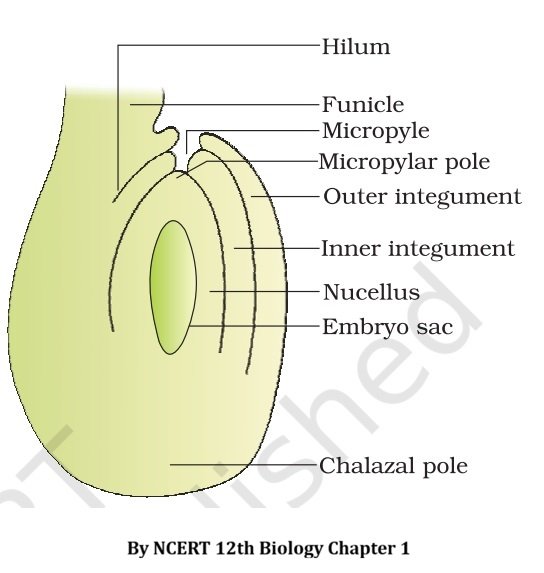
A typical angiosperm ovule is the structure within the ovary that develops into a seed after fertilization. It is usually anatropous (inverted) and consists of several well-defined parts:
Parts of an Angiosperm Ovule
1. Funiculus
- A stalk-like structure attaching the ovule to the placenta (ovary wall).
- It acts as a conduit for nutrients from the plant to the ovule.
2. Hilum
- The point of attachment between the funiculus and the ovule.
- Visible later as a scar on the seed.
3. Raphe
- A ridge formed by the fusion of the funiculus with the body of the ovule.
- Common in anatropous ovules.
4. Integuments
- Protective outer layers (usually two layers: outer and inner integuments).
- They surround the nucellus, leaving a small opening called the micropyle.
5. Micropyle
- A tiny opening at one end of the ovule.
- Allows entry of the pollen tube during fertilization.
6. Nucellus
- The central mass of parenchymatous tissue.
- Functions as nutritive tissue for the developing embryo sac.
7. Embryo Sac (Female Gametophyte)
- Located within the nucellus.
- Typically 7-celled, 8-nucleate structure, consisting of:
- Egg cell
- Two synergids
- Three antipodal cells
- Two polar nuclei (central cell)
8. Chalaza
- The basal region of the ovule, opposite the micropyle.
- Region where integuments and nucellus meet.
1. Name the parts of an angiosperm flower in which development of male and female gametophyte take place.
2. Differentiate between microsporogenesis and megasporogenesis. Which type of cell division occurs during these events? Name the structures formed at the end of these two events.
3. Arrange the following terms in the correct developmental sequence: Pollen grain, sporogenous tissue, microspore tetrad, pollen mother cell, male gametes.
